Economy
How to Prepare for a Financial Downturn Before Income Falls
A household plan for weaker income, higher costs or job loss: know your survival budget, build liquid reserves, reduce fixed commitments and decide what happens first.
A financial downturn rarely arrives at the kitchen table as a neat headline. It shows up as fewer shifts, a client paying late, higher loan costs, a contract that is not renewed or a job search that takes longer than expected. You cannot control the economy. You can make the household less brittle before income falls.
This is resilience planning, not market forecasting
Start with the number your household must cover
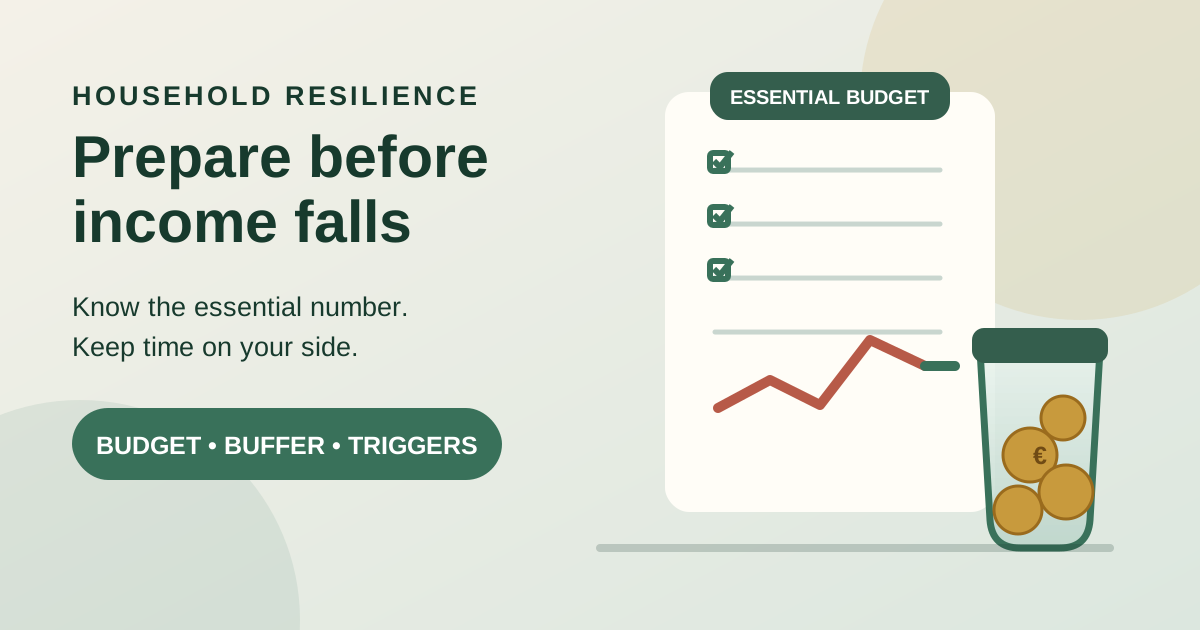
Build a survival budget beside your normal budget. Use reliable net income only. List housing, basic utilities, food, essential transport, insurance, medicines, childcare and minimum contractual payments. Annual costs such as tax, school expenses or insurance premiums need a monthly share. Banco de Portugal advises separating certain from uncertain income, necessary from optional expenses, and fixed from variable costs.[1]
- Essential monthly cost: what keeps the household housed, fed, insured, connected and able to work or seek work.
- Monthly margin: reliable net income minus essential monthly cost.
- Cash runway: accessible emergency savings divided by essential monthly cost.
- Concentration risk: how much household income disappears if the largest salary, client or contract stops.
Run three household stress tests
Build the reserve in useful stages
There is no single correct emergency-fund target. A household with two stable incomes, strong insurance and low fixed costs has a different risk from a freelancer supporting children. Keep the reserve safe, accessible and separate from everyday spending. Start with one week of essentials, then one month, then extend it according to your exposure. CFPB guidance also treats the amount as situation-specific and recommends a dedicated place for emergency savings.[2]
- Automate a small transfer just after income arrives.[2]
- Send part of bonuses, refunds or unusually strong freelance months to the reserve.
- Refill the reserve after using it; that is what it is for.
- Do not count a credit-card limit or a volatile investment as cash available for next month's rent.
- Keep a modest amount of physical cash for payment outages, but do not store sums that create a theft risk.[2]
Keep access as well as money
Lower fixed costs before they become urgent
Fixed commitments reduce room to manoeuvre. Review housing, vehicles, insurance, telecommunications, subscriptions and debt while income is intact. The useful question is not whether an expense is pleasant. It is how quickly you can change it and what damage follows if you stop paying.
- Cancel services nobody uses and remove duplicate cover.
- Compare providers before renewal dates, without sacrificing cover you could not afford to replace yourself.
- Avoid adding new instalment plans for optional purchases.
- Pay down expensive variable-rate or revolving debt when this does not empty the emergency reserve.
- Keep a written list of contract end dates, notice periods and early-termination costs.
Protect income before you need replacement income
Save copies of employment contracts, recent payslips, performance records, qualifications and contact details for people who know your work. Update the CV and professional profile before a layoff is announced. Freelancers should reduce dependence on one customer and know which invoices are overdue. Check unemployment, housing, health and family benefits where you live; eligibility and application deadlines differ by country.
If work stops, apply and call early
Use a payment order, not panic
If cash cannot cover every bill, protect immediate safety and earning capacity first: housing, basic utilities, food, necessary medicine, insurance and transport needed for work. Legal consequences vary, so use a reputable local debt adviser for the exact order. Do not ignore creditors. Explain the income change, state what you can pay, ask about hardship options and get any agreement in writing.[4]
Debt relief attracts fraud
Write the trigger plan on one page
- Yellow: income becomes less certain. Pause new commitments, move extra cash to the reserve and update documents.
- Orange: income falls or a job is at risk. Switch to the survival budget, apply for support and contact creditors before missing payments.
- Red: the next 30 days are not funded. Protect essentials, stop nonessential automatic payments, seek qualified debt or housing advice and involve every adult in the household plan.
- Recovery: restore overdue essentials, rebuild a small reserve and only then restart optional spending or aggressive debt overpayments.
Sources and limits
This guide uses general consumer guidance from Banco de Portugal, CFPB, Ready.gov and the FTC. Benefits, creditor rights, insolvency rules, deposit protection and tax treatment depend on your country and contract. For decisions involving investments, pensions, insolvency or selling a home, use a regulated adviser or qualified legal professional in your jurisdiction.
[2] Building an emergency fund
The useful preparation is boring
Know the essential monthly number. Keep some money liquid. Reduce commitments that are hard to change. Preserve documents and income options. Decide in advance which actions start when income falls. None of this predicts the next downturn; it gives the household time to make better decisions if one arrives.
Contains affiliate links. Provision may earn a commission if you buy through them, at no extra cost to you. This does not affect our recommendations.