Medical
CoQ10 and Heart Resilience in Emergencies: What It Can — and Cannot — Do
Coenzyme Q10 is central to cellular energy, but a supplement is not a shield against emergency stress. Here is the evidence and the heart-smart plan that matters first.
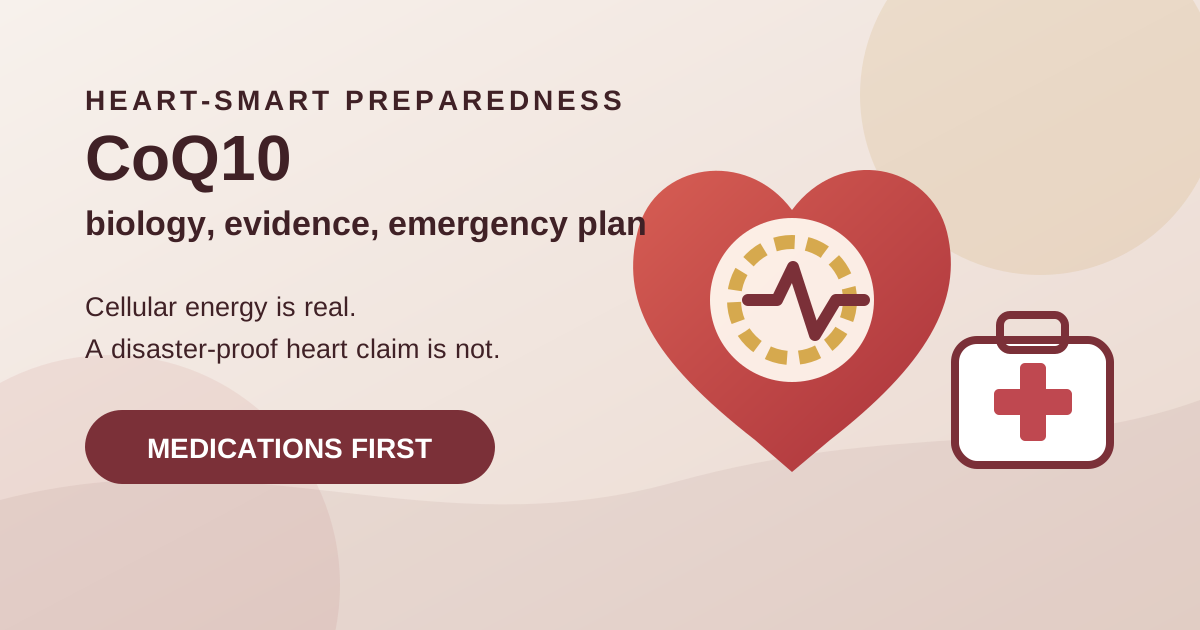
An emergency can put the heart under several pressures at once: fear, interrupted sleep, heavy work, heat or cold, smoke, dehydration, missed meals and disrupted access to medication. Coenzyme Q10 is often marketed as a way to 'strengthen' the heart through that stress. Its biology is real, but that emergency-protection claim goes beyond the evidence.
What CoQ10 does in the body
Coenzyme Q10, also called ubiquinone, is made by the body and is present in every tissue, with high concentrations in energy-demanding organs such as the heart. In mitochondria it helps transfer electrons in the process that produces ATP, the chemical energy used by cells. Its reduced form also participates in antioxidant systems.
A biological role is not a treatment claim
Does it fortify the heart against emergency stress?
No clinical evidence shows that starting CoQ10 before or during a disaster prevents a heart attack, offsets acute psychological stress or lets someone safely work beyond normal limits. EFSA reviewed claims involving energy metabolism, blood pressure, oxidative protection, cholesterol, cognition and endurance and did not establish the proposed cause-and-effect relationships for the general population.
Do not turn mechanism into certainty
Where the cardiovascular evidence is most interesting
The strongest clinical interest is in people who already have heart failure, as an addition to medical treatment. A Cochrane review of 11 randomised trials with 1,573 participants found signals of fewer deaths and heart-failure hospitalisations, but studies were small or inconsistent and the effects on heart function, exercise capacity, heart attack and stroke remained uncertain. The reviewers concluded that there was no convincing evidence to support or refute its use.
Adjunct means alongside treatment
Food sources belong in the ordinary emergency menu
The body synthesises CoQ10, so it is not treated like a vitamin with an established daily dietary requirement. Food contributes smaller amounts. Meat, poultry and fish are among the richer sources; nuts and vegetable oils also contribute. In a preparedness pantry, those foods earn their place mainly because they provide protein, energy and useful fats, not because anyone needs to hit a CoQ10 target.
Build a complete ration
The heart-resilience layer that matters first
- Keep an up-to-date medication list, doses, diagnoses, allergies, clinician and pharmacy contacts in the go-kit.
- Maintain an emergency reserve of prescribed medicines where local rules and your clinician allow it; rotate it and never replace it with a supplement.
- Protect sleep, hydration and regular meals as far as conditions permit.
- Pace heavy lifting and heat exposure; emergency adrenaline can hide warning signs until the workload becomes dangerous.
- Avoid tobacco, excess alcohol and excessive caffeine used to push through fatigue.
- Know the local emergency number and the warning signs of heart attack or stroke; supplements are irrelevant when urgent care is needed.
Stress plus interrupted care is the real combination
If CoQ10 is already part of your plan
- Continue it only as agreed with the clinician who knows your condition and medication list.
- Keep it in the original, labelled container and rotate by expiry date; do not decant anonymous capsules into a kit.
- Do not start, stop or increase it during a crisis to treat chest pain, breathlessness or unusual fatigue.
- Ask about interactions: CoQ10 may interact with warfarin and insulin and may not be compatible with some cancer treatments.
- Record the product, form and dose on the same medication sheet as prescriptions so emergency clinicians know what you take.
Key takeaway
CoQ10 has a genuine role in cellular energy and some promising but unsettled evidence in heart failure. It has not been shown to fortify a healthy heart against emergency stress. Real cardiovascular resilience comes first from uninterrupted prescribed treatment, hydration, food, sleep, workload control, medical information and fast recognition of warning signs. CoQ10 may be an optional clinician-approved adjunct — never the shield.
Contains affiliate links. Provision may earn a commission if you buy through them, at no extra cost to you. This does not affect our recommendations.